
Overview
The Business Footprint Verification (BFV) is used to validate that a business exists based on its broader commercial and digital presence—not just government-issued records. If you’re interested in using it, please contact your Persona account team.
Organizations use the BFV to:
Validate and verify business existence
A Business Footprint Verification checks that business information an end-user provides—such as name and business address—matches a business profile built from third-party data sources. These include trade records, public data, and aggregated commercial databases. A match in any approved dataset can result in a passed verification.
Expand coverage beyond issuing data
Unlike the Business Registry Verification (BRV), which matches against authoritative government registries, the BFV leverages sources that are not issuing authorities. This allows for broader coverage—especially for small businesses, sole proprietors, or merchants with incomplete or inconsistent registry data.
Support flexible KYB and fraud use cases
The Business Footprint Verification is best suited for onboarding and fraud prevention use cases where formal registry validation isn’t required. It provides a way to validate that a business is “real enough” for marketplaces and platforms looking to reduce friction while maintaining trust.
How the Business Footprint Verification works
At a high level, the Business Footprint Verification works as follows:
-
Submission of information
End-users submit the business name and business address. While these attributes can be configured to be optional, providing more information increases Persona’s ability to return a match. We recommend requiring both fields to maximize match rates.
-
Match against commercial data sources
Persona normalizes the provided inputs and checks them across a network of U.S.-focused data sources that include:
- Aggregated business databases (e.g. Enigma Brands, D&B)
- Authoritative identity providers (e.g. TransUnion Business Records – future support)
- Public records, licensing, card transactions, and web directories
Matching within the BFV uses Contextual Matching to allow for fuzzy and field-specific matching rules.
-
Return verification result
Persona returns a pass or fail result based on whether any match group satisfies the identity comparison check. As long as one of the applicable match groups meets the configured requirements, the BFV will pass.
Understanding Business Footprint sources
The BFV pulls from a wide range of non-issuing data sources (confidential) to determine whether a business has a valid commercial presence. These sources provide a more complete picture of a business’s presence—especially when government registry records are unavailable or outdated.
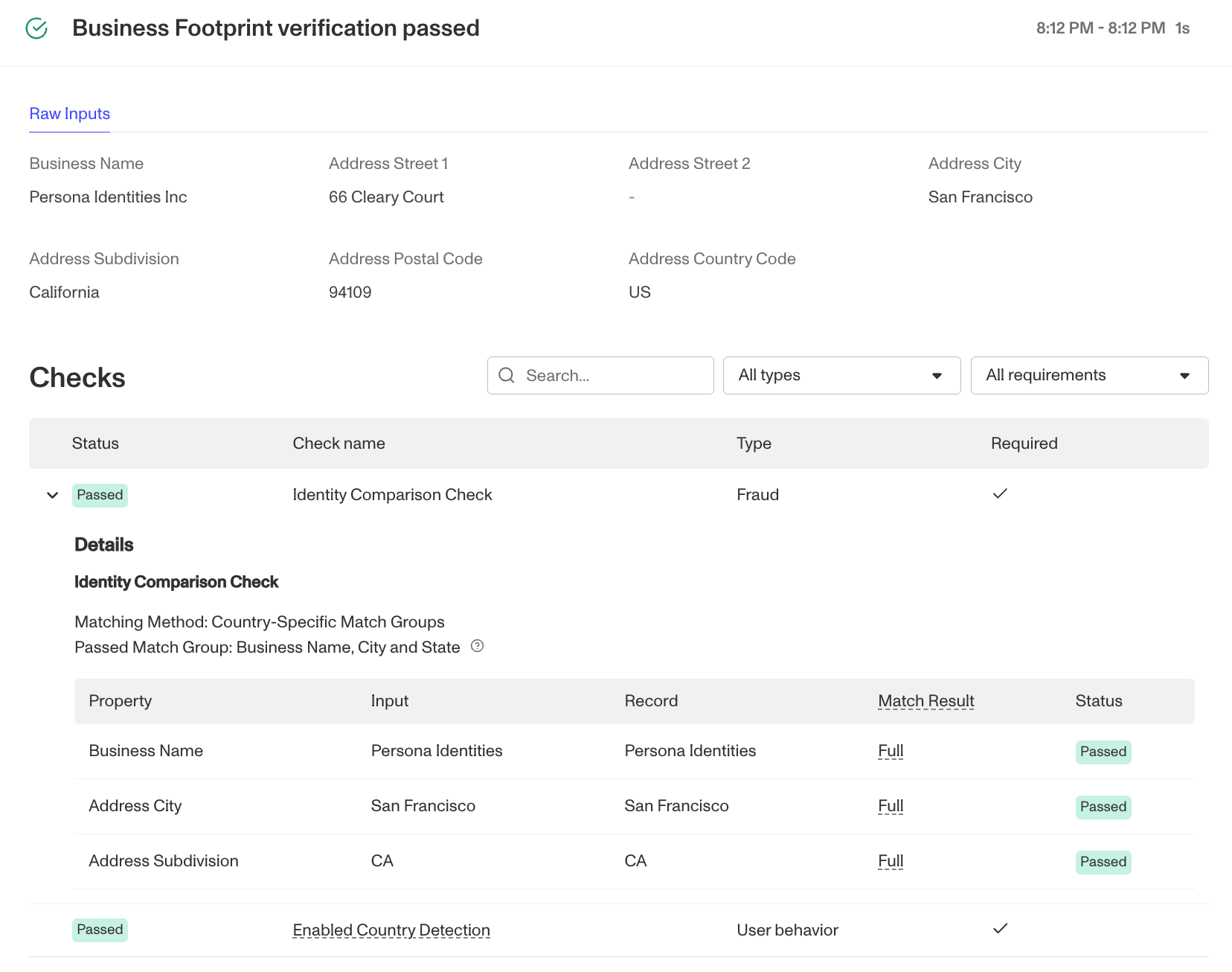
This approach helps paint a fuller picture of a business’s presence—especially when government registry records are missing, outdated, or incomplete. It’s particularly helpful for merchants who are actively operating or transacting but may not yet be formally registered with a government authority.
Default match groups within the Business Footprint Verification
Because each source may use different naming conventions, address formats, and business metadata, the BFV applies default match groups optimized for U.S. businesses. These match groups consist of:
- Source-specific normalization methods (e.g. USPS-standardized addresses)
- Comparison thresholds for fields like name, city, and state
- Field-specific match weights (e.g. stricter on city/state, looser on street)
These groups are editable in the verification template and can be configured with your Persona account team to match your business rules and risk tolerance.
Frequently Asked Questions
What is the difference between the Business Footprint Verification and Business Registry Verification?
The BRV checks government-issued records and is ideal for regulatory or compliance use cases. The BFV, on the other hand, uses aggregated commercial data and is ideal when broader coverage is needed or when issuing data is unavailable or inconsistent.
Can I use the Business Footprint Verification for compliance use cases?
We do not recommend using BFV when registry data is required for regulatory compliance. For those scenarios, BRV, TIN (U.S.), or VAT (EU) verifications are more appropriate.
Does the Business Footprint Verification support global businesses?
Currently, the BFV is limited to U.S. businesses. Future updates may add support for international data coverage.
Can I combine this with other verifications?
Yes. Many organizations use BFV in combination with BRV or TIN checks—either as a fallback for broader match coverage or as a step in fraud/risk workflows where issuing data isn’t required.
Plans Explained
Business Footprint Verification by plan
| Startup Program | Essential Plan | Growth Plan | Enterprise Plan | |
|---|---|---|---|---|
| Business Footprint Verification | Not Available | Not Available | Not Available | Available |