
Overview
The Data Table module enables you to configure a data table over a list of items, with each column showing an attribute, field, or piece of metadata from each item.
Data tables are ideal when:
-
You have information that is best displayed in a table
- You need to scan or compare many records at once rather than drilling into one
- The list is potentially large and requires pagination
- The data is homogeneous — every row has roughly the same shape (same attributes/fields)
- You want consistent, typed column formatting across rows
-
You want reviewers to run actions on selected rows
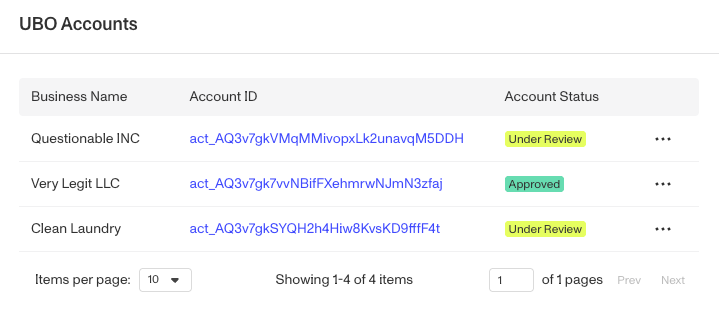
This is an example of a Data Table module displayed within a Case.
How do you add an Data Table module?
- Navigate to the Dashboard, and click on Cases > Templates.
- Find and click on the Case template you want to edit, or click Create template to make a new one.
- Navigate to the Tab you want to add the module to. Click an empty space to view the Component Library.
- In the right toolbar, search for ‘table.’
- Drag and drop the Data Table module into your layout and reposition it by dragging it around.
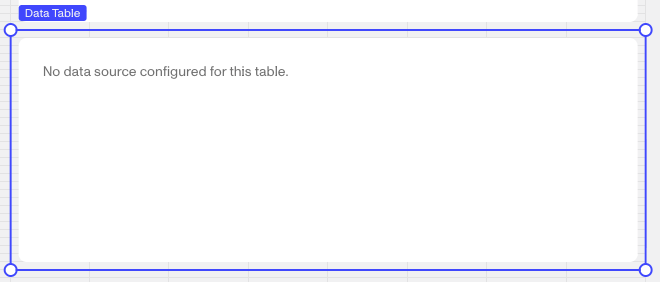
- Click on the Data Table module on the right toolbar you can customize how information is displayed on the module.
- Under Properties, you can:
- Update the module title.
- Change the Data source, ie the object the table is pull it’s data from.
- Edit, Add, and Remove table columns. More detail below.
- Under Interaction, you can choose the Actions for the module. Actions are one-click macros that run a pre-set Workflow automatically (for example, Update fields, Update tags, or Redact). Click the ”+” to add an Action. For more, see Cases: Module Actions.
- Under Module Layout, you can change:
- Dynamic height: Module will grow or shrink to fit its contents.
- Visibility: Dynamically control whether the module is hidden. This is a toggle button that lets you set conditions for when the button should be displayed or hidden from view based on your case requirements. You can read more about Visibility Configuration here.
- Under Properties, you can:
- Click the “Delete” button if you want to remove the component from the layout.
Column configurations
The Data Table module allows you to configure specific columns to display from available data. The module is often used to enrich a users understanding of a specific Case.
Column Values vs Format
Columns include four standard fields:
- Label is the editable name for the column.
- Value is the data the column is being pulled from.
- Format is the structure of the data.
- Obscurable is a toggle that hides the data content by default.
Data content that has been hidden via Obscurable can be revealed with a single click, and then hidden again with another click.
Column values support 19 value types (string, number, date, file, etc) and each type allows certain formats. The Format determines how the value are displayed and rendered. If you select a value type, the format will be updated to show the available formats. You can also directly select a format, but it will not limit which value types you can select. Once a format is selected, additional related fields may be added or removed.
The 19 Column value types are:
- String
- Number
- Integer
- Boolean
- Date
- Datetime
- Hash
- Array
- File
- Document
- Government ID
- Selfie
- Choices
- Multi-choices
Column formats
The Format determines how the value are displayed and rendered. Some column values support more than one Format. For example, a reference ID can be formatted as a String, URL, or Persona Token. You can learn more about column formats here.
The 11 supported column formats are:
- String
- Number
- Date
- Datetime
- Image
- File
- Sticker
- Boolean
- URL
- Persona token
Preview with Case
If you wish to see how the module will display with actual data instead of simulated placeholder data, you can use the Preview with Case feature to use one of your existing cases as example data.
Steps
-
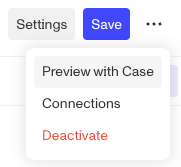
Go to the top right of the layout editor and click the 3 dot button.
-
From the dropdown, select Preview with Case.
-
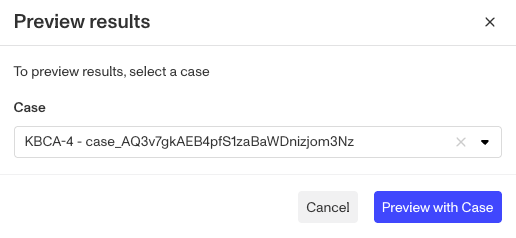
In the Preview results window, select the existing case from this template you’d like to use.
-
Click the Preview with Case button at the bottom right.
Module Actions
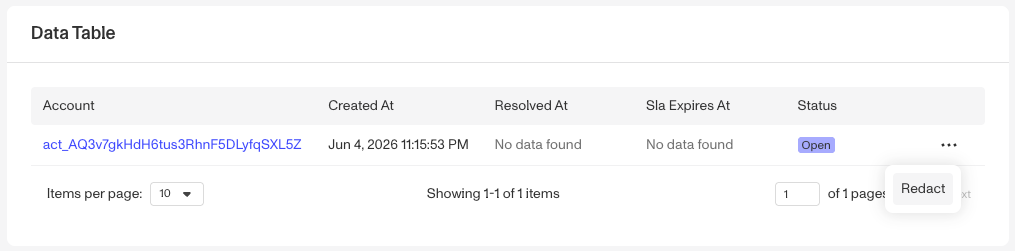
Module Actions allow you to configure existing case actions or a pre-built action onto the Data Table module. Once configured, a reviewer can run that action on a selected row within the Data Table.
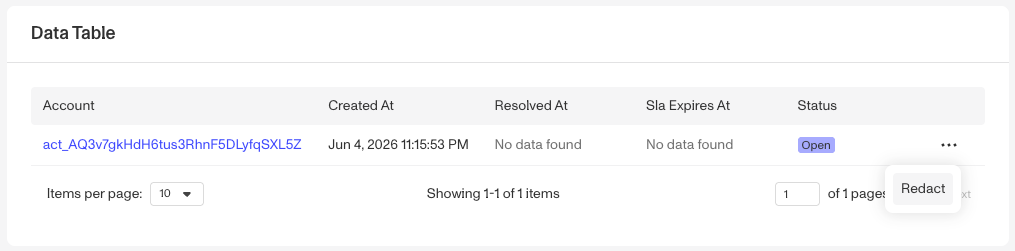
For example above, adding the pre-built Redact action allow you to click the 3 dot button at the right of a row and then select redact.
Mapping Actions to the Data Table
Some actions you configure have a “Params” section listing the fields the action requires. For every required param, the editor gives you a Smart Input whose available options are drawn directly from the data table’s own data source — i.e., the columns/fields of the rows shown in the table. You point each required action field at the corresponding data-table field, and at runtime when a reviewer selects a row and fires the action, the values from that row populate the action’s inputs.
Data tied to the current Case
The current case has many other personal objects attached to it and you can use those connection to have the data table pull from those attached object. In the example below, a Data Path from a case to an attached inquiry, and then the accounts from that inquiry is used to focus on accounts from the inquiry. Then filters can be applied on top of the data narrow to scope of data included.
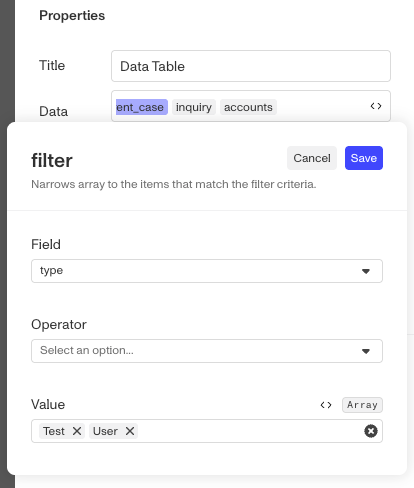
You can learn more about using Persona’s Smart Input tool to build Data Paths here.
Plans Explained
Data Table module by plan
| Startup Program | Essential Plan | Growth Plan | Enterprise Plan | |
|---|---|---|---|---|
| Data Table module | Available | Available | Available | Available |